
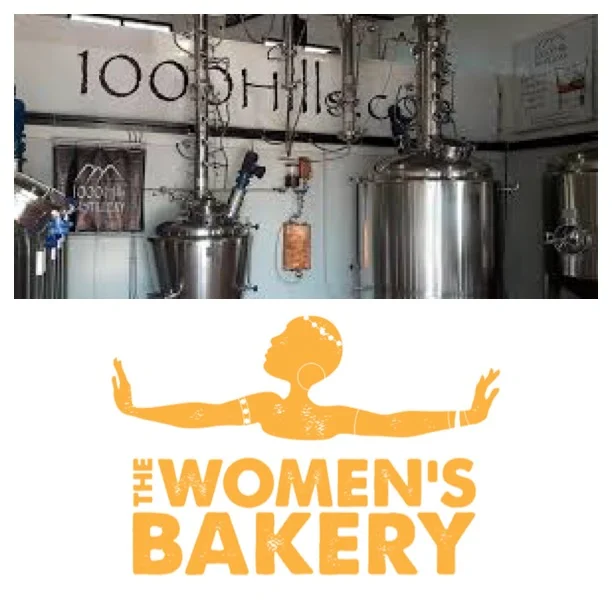
There’s a common misnomer that doing the right thing and profiting are mutually exclusive; this could not be less true, and 1000 Hills Distillery and the Women’s Bakery are two organizations that clearly dispel this misinformed notion.
On Wednesday, I went on a tour of 1000 Hills Distillery led by Andrew, one of their directors, who has experience in impact investing and microfinancing. He proudly led us through the distillery, which admittedly combines two of my favorite things: social impact… and libations. While the whole process and experience was awesome, there were several takeaways from this tour that stuck out:
They recycle rainwater that they use to help in the fermentation process, which is resourceful and great for the environment
They source their ingredients from Rwandan farmers, which not only provides them oversight of quality control, but also helps local business
They do not use any ingredients that are part of the “food chain” (i.e., what people in Rwanda could eat), which gives some of the liquors unique flavors. For instance, for their vodka, they use molasses in lieu of potatoes. Not only did the vodka taste better than the usual vodka I begrudgingly throw back to maintain a semblance of a figure, but it’s good to know it’s not being created at the expense of local malnourishment
It is the only distillery along the equator, and has hushed many naysayers who posited that the Rwandan climate could not accommodate distilling
All of the drinks were unique and tasty and the views of the city were incredible. The last piece that really resonated with me was when Andrew informed me that respecting the community was not just the right thing to do, but good business. 1000 Hills is positioned for some great success in the future and I’m pretty excited to tap into the Macademia Nut Liquor that I brought back with me (responsibly of course 😉).
Thursday morning, I went to the Women’s Bakery, a bakery and café located in Kigali, with three other locations in Rwanda and one in Uganda. I had an hour-long discussion with Hilary Hilsabeck, the Director of Operations at the Bakery and indulged in a delicious cinnamon sugar pretzel and iced coffee.
One of the things about Women’s Bakery that really impressed me was their commitment to measuring social impact and profit concurrently. They do not make business decisions that compromise one of those goals. At their flagship locations, they pragmatically seek feedback from their female employees, and have adapted from a training/hands-off model, to providing more oversight into their operations, to ensure that the bakery remains profitable.
In an effort to expand, The Women’s Bakery allows reputable NGOs to franchise its business model and name (while taking on the financial risk of operating the new location), and Women’s Bakery management provides training, consultancy, and report monitoring to help these locations get off the ground. This has posed certain challenges, like the lack of comparative regulations in Uganda compared to Rwanda, or that baristas were offering products in exchange for IOUs, which had a temporary negative effect on profits. However, the Women’s Bakery continues to refine its process and model and educate its employees on the importance of sticking to its core plan to maximize benefits for all involved. Its ability to scale is contingent on perfecting its process and practices, and I have no doubt that they are on the precipice of achieving that.
The Women’s Bakery also provides a nursery, mental health counseling, and teaches gender and reproductive health to its employees. When new Women’s Bakery employees are onboarded (and then 6 months, 12 months, and annually thereafter), they respond to an 80 question survey about their financial and personal well-being. Questions include whether their house has cement floors, whether they can afford a cow or school fees all the way to more qualitative questions about mental health, confidence, and a variety of other metrics. The Women’s Bakery management also does home visits to ensure that the women’s lives have improved and that their survey responses reflect the actual improvement in their day-to-day lives. The Bakery even has an “Impact Wall” that touts the tangible impacts the Women’s Bakery provides (employees on average quadrupled their pre-Bakery income), they’ve sold over 115K pieces of bread, and have employed over 11 women at their main location thus far.
Both 1000 Hills and the Women’s Bakery were inspiring places that strengthened my belief that responsible business can be profitable and improve the lives of all stakeholders, especially when management is diligent, purposeful, and calculated. Thank you again to both organizations for welcoming me and entertaining my plethora of questions.